
Inaticabtagene autoleucel
A CD19-targeted CAR T-cell therapy for certain relapsed or refractory B-cell cancers — including large B-cell lymphoma and B-cell acute lymphoblastic leukemia. Made from your own immune cells, delivered at SinoUnited Health in Shanghai.
Also known as CNCT19 · inaticabtagene autoleucel · CD19-directed autologous CAR-T
A plain-language look at what CNCT19 is and how it works — general to this class of therapy, not specific to any one patient's result.
Inaticabtagene autoleucel — CNCT19 for short — is a type of CAR T-cell therapy. Your own T-cells (part of your immune system) are collected, then re-engineered to recognize a protein called CD19 that sits on the surface of B-cells. Once returned to your body, these modified cells seek out and destroy the cancerous B-cells.
It is an autologous therapy, meaning it is made from your own cells rather than a donor's. CNCT19 is a CD19-directed CAR T-cell therapy developed in China and approved by China's National Medical Products Administration (NMPA). Its large B-cell lymphoma indication was approved on 28 November 2025, and it is also approved in relapsed or refractory B-cell acute lymphoblastic leukemia.
Eligibility depends on your specific diagnosis — see the condition page.
CNCT19 follows the same CAR T-cell pathway as other therapies of its class — offered at SinoUnited as an all-inclusive “2+21” package across two trips to Shanghai, with the manufacturing weeks spent at home.
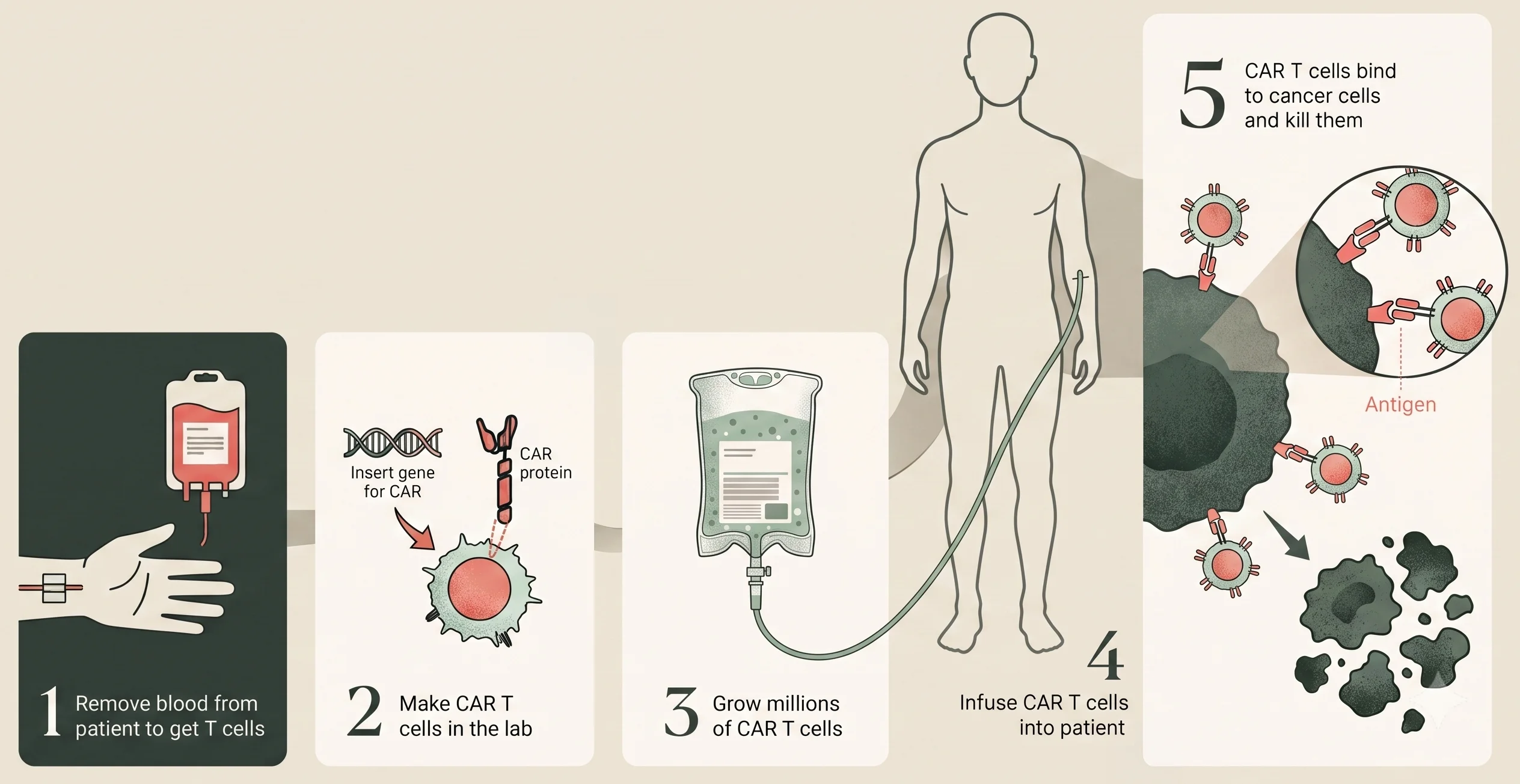
Blood and eligibility tests, then your T-cells are collected by apheresis — both done on-site at SinoUnited Health.
Trip one · ~1 week, ShanghaiYour cells are engineered to target CD19 and expanded while you return home and wait.
3–4 weeks · at homeA short course of chemotherapy prepares your body to receive the engineered cells.
Trip two · ShanghaiYour CNCT19 is returned in a single infusion, followed by close inpatient monitoring.
Trip two · ~3 weeks, ShanghaiThe full pathway at SinoUnited spans approximately two months across two trips to Shanghai, with the manufacturing period spent at home. See the patient journey for the detail.
Eligibility is set honestly here as a general guide — the decision itself rests with a qualified physician who has reviewed your case.
Eligibility depends on your specific diagnosis — see the condition page. This is a general guide only; whether CNCT19 is right for you is a decision made by a qualified physician after reviewing your individual case.
CNCT19 is directed at CD19, a protein expressed on the surface of B-cells — the lineage from which both of these cancers arise.
Large B-cell lymphoma (LBCL) is an aggressive cancer of the B-cells. Diffuse large B-cell lymphoma (DLBCL) is its dominant subtype and the term most patients search for — the approval is written for LBCL, and DLBCL falls within it.
For disease that has relapsed or become refractory after earlier treatment, CD19-directed CAR T-cell therapy is an established option, targeting the CD19 protein carried on the surface of the cancerous B-cells.
DLBCL detailsB-cell acute lymphoblastic leukemia (B-ALL) is a fast-growing cancer of immature B-cells in the bone marrow. It is treated with intensive chemotherapy, but can return or stop responding.
For relapsed or refractory disease, CD19-directed CAR T-cell therapy targets the CD19 protein expressed on the leukaemic B-cells.
B-ALL detailsTwo blocks, kept deliberately separate: what is true of this class of therapy in general, and what SinoUnited provides.
Like all CAR T-cell therapies, CNCT19 can cause side effects that need close monitoring. The two most discussed are cytokine release syndrome (CRS) — the immune system reacting as the therapy works — and neurological effects (ICANS). Most cases are manageable when caught early, which is why treatment is delivered as an inpatient stay with continuous monitoring.
SinoUnited Health provides infusion and recovery as a supervised inpatient stay in 100-level laminar-flow rooms, with on-site intensive care available if escalation is ever needed.
Tocilizumab, the standard treatment for severe cytokine release syndrome, is available on site.
5on-site ICUsSinoUnited's CAR-T program has Dr. Lily Zhou, M.D., Ph.D., Chief of Hematology — with a postdoctoral fellowship at UCSF and 25 publications indexed in PubMed, working within the Shanghai Ruijin Consortium of Blood Disease. CNCT19 is delivered as part of that program.
Any results, once published, describe the patients they concern — they are not, and must not be read as, a prediction of outcomes for any individual. Outcomes vary and are determined by individual circumstances.
Meet Dr. Zhou
SinoUnited offers CAR-T as an all-inclusive “2+21” package — covering the collection stay and the three-week infusion stay. The full breakdown of what's included, and pricing, lives on the Costs page as a single source of truth.
It is delivered at SinoUnited Health in Shanghai. Both collection and infusion are done on-site — they cannot be carried out in your home country.
About two months across two trips to Shanghai, with the four-to-six-week manufacturing period spent at home in between.
CAR-T is offered as one all-inclusive “2+21” package. The full cost breakdown is set out on the Costs page.
The most discussed are cytokine release syndrome (CRS) and neurological effects (ICANS), which is why treatment is delivered as a monitored inpatient stay. SinoUnited-specific detail will be added once confirmed by Dr. Zhou.
Yes. SinoUnited coordinates follow-up with your local physicians, with three-monthly reviews recommended after treatment.
Start a remote assessment before you travel. It asks only for basic contact details and your diagnosis — your records are then reviewed by Dr. Zhou's hematology team.